
8 Easy Ways: How to Save Gas on a Road Trip Without Mistakes
Learning how to save gas on a road trip is simple once you know where the fuel really goes. The short answer is to drive near the speed limit and keep your tires at the right pressure. Pack light, keep cargo off the roof, plan cheaper fuel stops, and cut idling. Those six habits can save a typical driver 15 to 25 dollars on a 500-mile trip. This guide shows you eight easy ways, the costly mistakes, and a dollar scorecard.
ANSWER BOX 1: To save gas on a road trip, drive at 65 mph or less and use cruise control on flat highways. Keep tires at the pressure on the door sticker, and remove roof cargo. Plan fuel stops with GasBuddy or a similar app, and turn the engine off when you wait more than a minute. These habits can cut fuel use by 10 to 30 percent on long highway trips.
ANSWER BOX 2: A 500-mile trip in a car that gets 25 miles per gallon uses 20 gallons of fuel. At the AAA national average of $3.91 per gallon for regular fuel on 12 November 2026, that trip costs about $78.20. Slowing down and driving smoothly can save $8 to $12 on that same trip. Tires, roof cargo, and idling can save several dollars more.
How Much Can You Really Save on Gas?
Many drivers think fuel savings come from small tricks, but the numbers tell a bigger story. The U.S. Department of Energy runs fueleconomy.gov with the U.S. Environmental Protection Agency, and its figures show that driving style is the largest single factor you control. Aggressive driving means speeding, rapid acceleration, and hard braking. It can lower gas mileage by roughly 15 to 30 percent at highway speeds. The same source puts the loss at 10 to 40 percent in stop-and-go traffic.
How to Save Gas on a Road Trip: 8 Easy Ways That Work
These eight ways are listed in order of impact. Small changes stack up, but they overlap, so do not add every dollar figure together. The scorecard below shows the honest combined total.
1. Slow Down to 65 Miles Per Hour or Less
Speed burns extra fuel fast, and it is the easiest waste to fix. Wind resistance grows sharply as speed rises, so your engine works much harder at 75 than at 65. Each 5 miles per hour over 50 costs about 7 percent of your mileage, according to fueleconomy.gov. Dropping from 75 to 65 can save about 14 percent, close to $11 on a 500-mile trip.
2. Drive Smoothly and Use Cruise Control
Smooth driving means gentle starts, early braking, and a steady speed. Aggressive driving can lower gas mileage by roughly 15 to 30 percent at highway speeds, according to fueleconomy.gov. Look far ahead, lift off the gas early when traffic slows, and avoid racing toward red lights. Cruise control helps on flat highways by holding one steady speed.
3. Check Tire Pressure Before You Leave
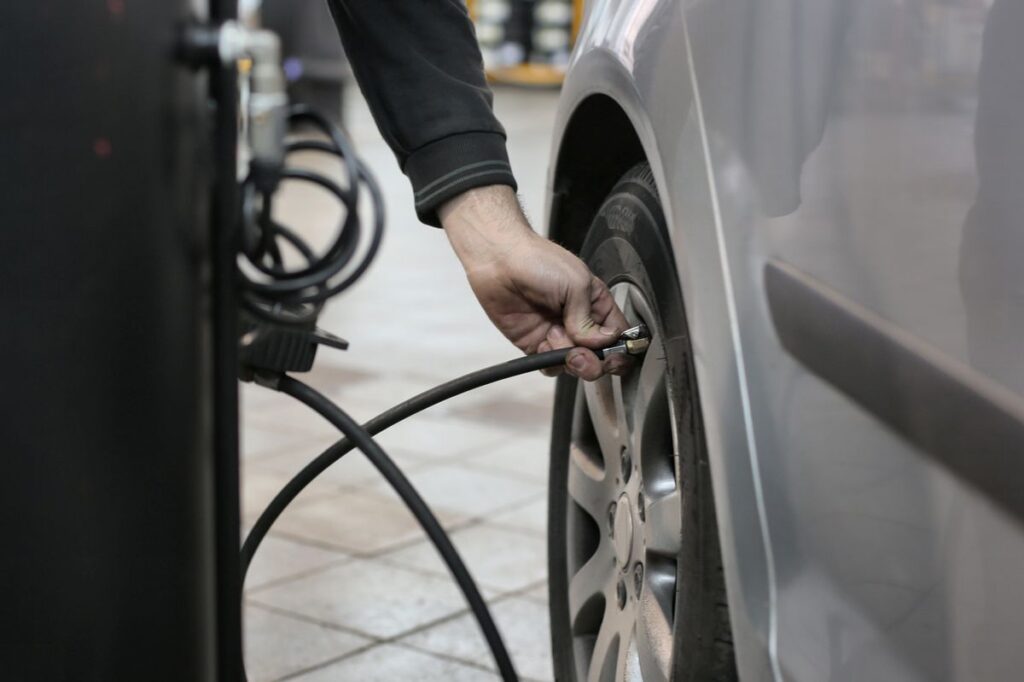
Tires are easy to forget, and low pressure quietly wastes fuel on every mile. Underinflated tires can lower gas mileage by about 0.2 percent for every 1 psi drop, according to fueleconomy.gov. Keeping tires at the right pressure can improve mileage by up to 3 percent in some cases. Check the pressure when the tires are cold, and use the number on the driver door sticker.
4. Pack Light and Keep Cargo Off the Roof
Weight and wind drag are silent fuel thieves, and both are easy to control. An extra 100 pounds can cut fuel economy by about 1 percent, according to the U.S. Department of Energy. Roof cargo is far worse because it breaks the smooth airflow over the car. A large rooftop cargo box can cut fuel economy by 6 to 17 percent on the highway. At interstate speeds, the loss is 10 to 25 percent, according to fueleconomy.gov.
5. Plan Cheaper Fuel Stops Before You Go
Fuel prices can vary by 30 to 50 cents per gallon between stations only a few miles apart. Highway exit stations charge the most because they know tired drivers will stop there. A short detour of two miles off the interstate can save $4 to $10 on a full tank. Use GasBuddy, AAA, or a similar app to compare prices before you leave. If you want the full math for your route, read how to calculate gas cost for a road trip.
6. Cut Idling to Almost Zero
Idling burns fuel while the car goes nowhere, so it gives you zero miles per gallon. An idling car can use a quarter to a half gallon of fuel per hour, according to fueleconomy.gov. Restarting uses only about 10 seconds worth of fuel. Switch the engine off when you wait more than a minute. Switch off at long railroad crossings, at drive-through lines that do not move, and while you wait for a passenger.
7. Use the Right Octane and Use Air Conditioning Wisely
Premium fuel does not help a car built for regular fuel, and buying it is pure waste. Check your owner manual for the octane your engine needs, and buy only that grade. Premium costs 40 to 60 cents more per gallon with no benefit. That adds $8 to $12 to a 500-mile trip. Air conditioning also costs fuel, but it is cheaper than open windows at highway speed.
8. Plan a Smooth Route and Avoid Traffic Jams
The shortest route is not always the cheapest route, because stop-and-go traffic burns far more fuel than steady highway driving. Aggressive stop-and-go driving can lower mileage by 10 to 40 percent, according to fueleconomy.gov. Check traffic before you leave and pick a departure time that avoids the worst rush hours. If your route crosses into Canada or Mexico, convert distances first with the miles to kilometers guide.
Your 500-Mile Savings Scorecard: What Each Tip Is Worth
This scorecard is the part other guides skip, because it turns vague advice into real dollars. Every figure below is worked out for one clear trip. The trip is 500 miles, in a car that gets 25 miles per gallon, with fuel at $3.91 per gallon. That is the AAA national average on 12 November 2026. That trip uses 20 gallons and costs $78.20.
| Tip | Fuel saving | Gallons saved | Dollars saved |
|---|---|---|---|
| Slow from 75 to 65 mph | 7 to 14 percent | 1.4 to 2.8 | $5.47 to $10.95 |
| Drive smoothly, no hard starts | 15 to 30 percent | 3.0 to 6.0 | $11.73 to $23.46 |
| Fix tire pressure | 0.6 to 3 percent | 0.1 to 0.6 | $0.47 to $2.35 |
| Remove roof cargo box | 10 to 25 percent | 2.0 to 5.0 | $7.82 to $19.55 |
| Leave 100 pounds at home | About 1 percent | About 0.2 | About $0.78 |
| Cut 30 minutes of idling | 0.25 to 0.5 gal per hour | 0.1 to 0.3 | $0.49 to $0.98 |
| Buy fuel 20 cents cheaper | 20 cents on 20 gallons | No gallons saved | $4.00 |
| Honest combined total | Tips overlap, do not add rows | 4 to 6 | $15 to $25 |
Slowing down and driving smoothly overlap heavily, since both fix the same wasteful driving style. A realistic driver who adopts the top five habits should expect to save $15 to $25 on a 500-mile trip. On a 1,000-mile round trip, that is $30 to $50 back in your pocket.
Mistakes That Waste Gas on a Road Trip
Every dollar in the scorecard above has a matching mistake. Most drivers make at least three of them on every trip. The table below lists the most common mistakes, what each one costs, and the fix that stops it. The fixes are all free or nearly free.
| Mistake | What it costs you | The fix |
|---|---|---|
| Driving at 75 to 80 mph | About 14 percent more fuel, near $11 | Set cruise control at 65 mph |
| Hard starts and hard braking | 15 to 30 percent worse mileage | Look ahead, brake early, drive calmly |
| Roof cargo box left on | 10 to 25 percent worse mileage | Pack inside, use a rear carrier, remove the box |
| Tires 5 psi low on all wheels | About 1 percent worse mileage | Check cold pressure, use the door sticker number |
| Overpacking by 100 pounds or more | About 1 percent worse mileage | Pack only what you need, leave the extras home |
| Idling at stops and drive-throughs | 0.25 to 0.5 gallons per hour | Turn the engine off for waits over one minute |
| Buying premium fuel your car does not need | 40 to 60 cents extra per gallon | Buy the octane your owner manual asks for |
| Fueling at interstate exit stations | 20 to 50 cents more per gallon | Compare prices on an app, fill up in town |
Speeding is the most expensive mistake for most drivers, and it is also the most common. A driver who slows to 65 saves about $11 per 500 miles and arrives only 20 to 30 minutes later. Packing mistakes are the easiest to fix, and drivers repeat them most often. A roof box acts like a sail at highway speed. Ask about each item: will we use this on this trip.
Before You Leave: The Night-Before Checklist
A good road trip is won the night before, not on the highway. Use this checklist the evening before you travel, and tick each item off as you finish it. Each item shows the saving it protects. The whole list takes about 20 minutes.
- [ ] Check cold tire pressure on all four tires plus the spare, to the door sticker number. Saving: up to $2.35 per 500 miles.
- [ ] Remove the roof box and roof rack if you do not need them. Saving: up to $19.55 per 500 miles.
- [ ] Take out every bag and item you will not use, aiming to cut at least 100 pounds. Saving: about $0.78 per 100 pounds.
- [ ] Fill the tank at a cheap town station, not at an interstate exit. Saving: about $4.00 per tank.
- [ ] Check the owner manual for the right octane and buy only that grade. Saving: $8 to $12 per 500 miles.
- [ ] Pack snacks and water in a cooler so you skip drive-through lines. Saving: less idling, plus food savings.
- [ ] Plan your fuel budget in the holiday budget calculator. Saving: a clear budget.
- [ ] Decide whether driving beats flying by reading is it cheaper to drive or fly. Saving: hundreds of dollars.
How to Save Gas on a Road Trip: FAQs
How much gas can I save on a road trip by slowing down?
Slowing from 75 to 65 miles per hour can improve fuel economy by 7 to 14 percent, according to fueleconomy.gov. On a 500-mile trip, that saves about $5 to $11 at $3.91 per gallon.
Does cruise control really save gas?
Yes, cruise control saves gas on flat highways because it holds one steady speed. Your foot makes small surges without you noticing, and each surge burns extra fuel.
What tire pressure should I use for a road trip?
Use the pressure on the sticker inside the driver door, not the maximum on the tire sidewall. Underinflated tires can lower gas mileage by about 0.2 percent for every 1 psi drop, according to fueleconomy.gov.
Does a roof cargo box really waste that much gas?
Yes, a large rooftop cargo box can cut fuel economy by 6 to 17 percent on the highway. At interstate speeds, the loss is 10 to 25 percent, according to fueleconomy.gov. A rear-mount box loses only 1 to 5 percent on the highway.
How much fuel does idling waste?
An idling car can use a quarter to a half gallon of fuel per hour, according to fueleconomy.gov. Turn the engine off whenever you wait more than a minute.
Is premium gas better for a road trip?
No, premium gas is not better unless your owner manual asks for it. For a regular car, premium wastes 40 to 60 cents per gallon with no benefit.
Do gas price apps really save money?
Yes, apps like GasBuddy and the AAA app show real prices along your route. Nearby stations can differ by 30 to 50 cents per gallon. Exit stations cost the most, while town stations are often cheaper.
Should I use air conditioning or open windows?
Use air conditioning on the highway and open windows only at low speeds in town. Open windows at 65 miles per hour create drag that can cost more fuel than the air conditioner.
How does extra weight affect gas mileage?
An extra 100 pounds can cut fuel economy by about 1 percent, according to the U.S. Department of Energy. Remove heavy items you will not use, such as tools, sports gear, and extra bags.
What speed gives the best gas mileage?
Most cars get their best mileage between 50 and 65 miles per hour, and mileage drops fast above 50. Each 5 miles per hour over 50 lowers fuel economy by about 7 percent, according to fueleconomy.gov.
Is it cheaper to drive or fly for a holiday trip?
It depends on distance, fuel price, and how many people travel together. Driving is often cheaper for families, since one tank of fuel carries everyone. Read is it cheaper to drive or fly for the full comparison.
How do I plan my gas budget for a road trip?
Divide your total miles by your car miles per gallon to get gallons, then multiply by the price per gallon. A 500-mile trip at 25 miles per gallon uses 20 gallons, which costs about $78 at $3.91 per gallon. Use the road trip gas cost calculator for your exact numbers.
Start Saving on Your Next Trip
Saving gas on a road trip is not about one big trick. It is about eight small habits that work together on every mile you drive. Those habits can save $15 to $25 on a 500-mile trip and $30 to $50 on a 1,000-mile round trip. Run your numbers in the road trip gas cost calculator and enjoy a cheaper holiday trip.
Learn more about the science behind these tips here: Fuel economy in automobiles