
Author Bio
Updated for 2026 | Last Updated: October 2, 2026 | Written by Laibii
A standard 2x4x8 stud counts as 5.33 board feet on a supplier sheet. However, it holds only 3.5 board feet of actual wood. That is a 52% gap between paper and real wood. As a result, many lumber budgets quietly fall apart. Order too little hardwood and you pay for a second delivery. In addition, you may see a color mismatch in the finished piece. Order too much and leftovers eat your margin.
A dependable board foot calculator closes that gap in seconds. However, it only works if you know what it measures. You also need the right dimensions to feed it. Finally, you must know how to read the answer. This guide covers the formula, hardwood pricing, and 4×8 stock. It also covers logs, standing trees, and linear feet. In addition, it covers the waste math most guides skip.
Try the Board Foot Calculator
Board Foot Calculator
Enter your sizes and click Calculate. A 2x4x8 stud is 5.33 board feet.
Also, use the board foot calculator above before you order. Then read the guide below for the rules behind it.
Key Takeaways
- One board foot equals 144 cubic inches. Also, one cubic foot equals 12 board feet.
- Softwood framing is priced on nominal sizes. As a result, real wood yield runs from 65.6% to 84.0%.
- Hardwood thickness uses quarter notation. For example, 4/4 means 1 inch in every calculation.
- Price per board foot is the only fair way to compare quotes. It works for per-piece, per-MBF, and per-linear-foot formats.
- Plan 20% to 30% extra for hardwood projects. For framing, plan less extra.
- Log and tree volume depends on the log rule. Doyle, Scribner, and International 1/4 inch give different answers.
First, start with the table of contents. Then get into the math.
Table of Contents
- Board Foot Calculator Basics: What You Are Really Measuring
- Board Foot Formula for Hardwood, Square Feet and 4×8 Stock
- Price per Board Foot Calculator: Real Costs in 2026
- Log and Tree Board Foot Calculator Methods for 2026
- Board Foot to Linear Foot Conversions Made Simple
- Waste, Grades and Limits of Any Board Foot Calculator
- Board Foot Calculator Comparison: Top Options at a Glance
- FAQ
Board Foot Calculator Basics: What You Are Really Measuring
Quick Answer: A board foot calculator converts thickness, width, and length into board feet. One board foot equals 144 cubic inches of wood. The core formula is thickness (in) x width (in) x length (ft) divided by 12.
Board foot is a unit of lumber volume equal to 144 cubic inches. It is the volume of a board 1 inch thick, 12 inches wide, and 12 inches long. The National Hardwood Lumber Association (NHLA) uses it for hardwood sales in North America. Think of it as a volume coin for pricing lumber. For example, it lets a yard price a skinny 8/4 plank and a wide 4/4 board on the same scale.
What does a board foot calculator actually do?
A board foot calculator multiplies your three dimensions. Then it divides by the right constant. As a result, you never touch the arithmetic. It also adds up multiple boards. In better tools, it applies a price and a waste factor. Honestly, the math is simple enough to do by hand. However, the value is in avoiding a slip at 6 p.m. with a cut list in one hand.
Why nominal sizes cause so many mistakes
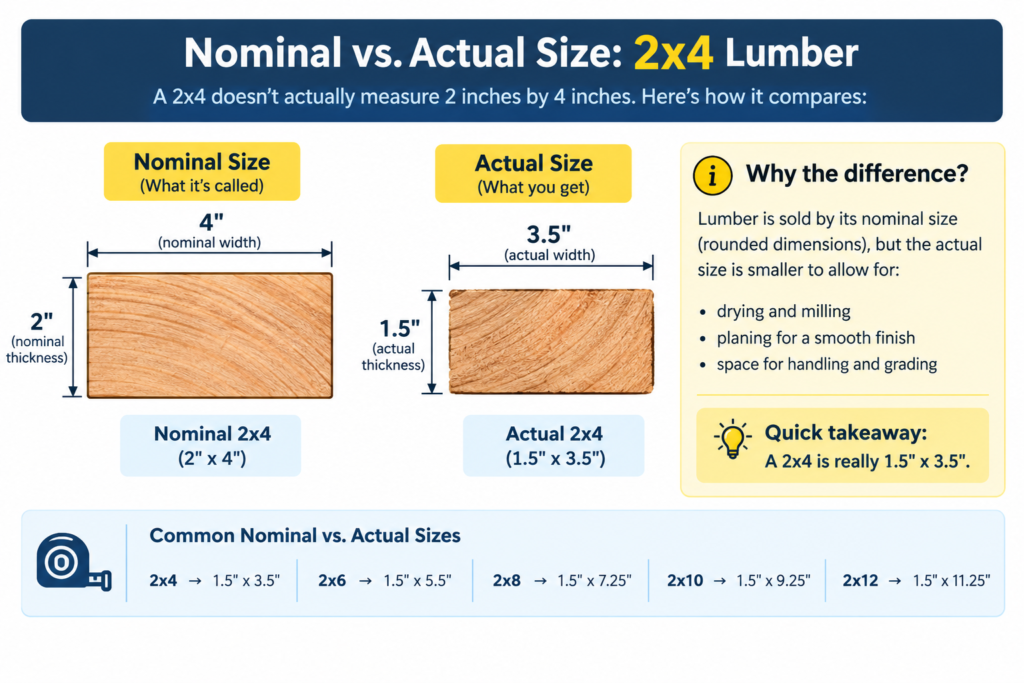
Nominal size is the name of a softwood piece, like 2×4, before drying and planing reduce it. The American Softwood Lumber Standard (PS 20) sets a dry 2×4 at 1.5 x 3.5 inches. Lumber also shrinks as it dries. Suppliers still price and tally on the nominal number.
Our Data: I recomputed real wood in seven common sizes using dressed dimensions. Real yield runs from 65.6% for a 2×4 to 84.0% for a 6×6. The average is about 71.6%.
| Nominal size | Actual size (in) | Nominal BF in 8 ft | Actual BF in 8 ft | Real wood yield |
| 1×6 | 0.75 x 5.5 | 4.00 | 2.75 | 68.8% |
| 2×4 | 1.5 x 3.5 | 5.33 | 3.50 | 65.6% |
| 2×6 | 1.5 x 5.5 | 8.00 | 5.50 | 68.8% |
| 2×8 | 1.5 x 7.25 | 10.67 | 7.25 | 68.0% |
| 2×10 | 1.5 x 9.25 | 13.33 | 9.25 | 69.4% |
| 4×4 | 3.5 x 3.5 | 10.67 | 8.17 | 76.6% |
| 6×6 | 5.5 x 5.5 | 24.00 | 20.17 | 84.0% |
The 12-Inch Sanity Check
I use a quick test before trusting any calculator result. The 12-Inch Sanity Check says board feet should be about 12 times cubic feet. If your answer looks far from that, something got typed wrong.
- First, convert each dimension to feet by dividing inches by 12.
- Then multiply the three numbers to get cubic feet.
- Next, multiply cubic feet by 12.
- Finally, compare with your calculator answer. They should match within rounding.
Pro Tip: A cabinet-shop friend sent a 620 BF order that felt high. The sanity check showed 52 cubic feet of boards, which is 624 BF. As a result, the order was fine. The quote tally showed 680 BF, and that number was off.
Q: Is a board foot the same as a cubic foot? No. A cubic foot holds 1,728 cubic inches, while a board foot holds 144. Therefore, one cubic foot equals 12 board feet.
Real example: Dana, a deck builder, orders 24 pieces of 2x6x12. On the nominal tally, that is 288 BF. The actual wood is 198 BF. At $0.95 per nominal BF, she pays $273.60. As a result, that is about $1.38 per real board foot.
Board Foot Formula for Hardwood, Square Feet and 4×8 Stock
Quick Answer: For hardwood, multiply thickness in inches by area in square feet to get board feet. A 4×8 sheet of 3/4 inch plywood works out to 24 board feet by the same logic.
Quarter notation counts hardwood thickness in quarters of an inch. For example, 4/4 is 1 inch, 5/4 is 1.25 inches, and 8/4 is 2 inches. Dealers quote rough thickness, even when the board gets planed afterward.
| Quarter | Rough thickness | Typical surfaced thickness | BF in a 6 in x 8 ft board |
| 4/4 | 1.00 in | 13/16 in | 4.0 |
| 5/4 | 1.25 in | 1 1/16 in | 5.0 |
| 6/4 | 1.50 in | 1 5/16 in | 6.0 |
| 8/4 | 2.00 in | 1 3/4 in | 8.0 |
| 12/4 | 3.00 in | 2 3/4 in | 12.0 |
How do you calculate board feet from square feet?
Multiply area in square feet by rough thickness in inches. A 4/4 board covering 11.67 square feet holds 11.67 board feet. This works because one square foot at 1 inch thick is exactly one board foot.
How many board feet are in a 4×8?
It depends on which 4×8 you mean. Here is the breakdown:
- A 4 ft x 8 ft sheet, 3/4 inch thick: 32 sq ft x 0.75 = 24 BF.
- A 4 inch x 8 inch beam, 10 ft long: (4 x 8 x 10) / 12 = 26.67 BF.
- A 4 inch x 8 inch beam, 12 ft long: (4 x 8 x 12) / 12 = 32 BF.
The Quarter-Notation Ladder
The Quarter-Notation Ladder converts any hardwood quote into math. Climb three rungs: read the quarter, convert to inches, then run the formula.
- First, read the thickness code on the quote, say 5/4.
- Then divide the top number by 4 to get inches, 5 / 4 = 1.25.
- Next, measure width and length of each board. For random-width stock, use averages.
- Finally, run thickness x width x length (ft) / 12, then total all boards.
Real example: Priya builds a bookcase with six shelves, each 36 x 11 inches, in cherry. Each shelf is 2.75 sq ft, so six shelves need 16.5 sq ft. At 4/4, that is 16.5 BF net. She adds 25% for waste and buys 21 BF. At $9 per BF, her lumber costs $189.
Pro Tip: Craftsmen Hardwoods notes that hardwood arrives in random widths. It cannot be guaranteed to match entered specs. When ordering 8/4 for a tabletop, ask for the widest boards. Also, enter the average width rather than your ideal one.
Q: What is the formula if my length is in inches? Divide thickness x width x length by 144 instead of 12.
Price per Board Foot Calculator: Real Costs in 2026
Quick Answer: A price per board foot calculator divides any quote by the board feet it covers. As a result, you can compare per-piece, per-linear-foot, and per-MBF prices fairly. Multiply price per board foot by total board feet for your lumber cost.
MBF is one thousand board feet, a unit mills and wholesale buyers use. A quote of $1,150 per MBF equals $1.15 per board foot. BuildVision AI lists softwoods around $2 to $5, common hardwoods $4 to $10, and walnut or cherry $8 to $15 or more.
How do you convert any quote to price per board foot?
Use the table below. Every row ends with the same unit. As a result, quotes become comparable.
| Quote format | What it means | Convert to price per BF | Worked example |
| Per board foot | Price on 144 cubic inches | No change | $14.00/BF stays $14.00 |
| Per MBF | Price on 1,000 BF | Divide by 1,000 | $1,150/MBF = $1.15/BF |
| Per piece | One board or stud | Divide by BF in the piece | $4.50 2x4x8 / 5.33 = $0.84/BF nominal |
| Per linear foot | One foot of length | Divide by (T x W / 12) | $3.50/LF of 4/4 x 6 / 0.5 = $7.00/BF |
| Per square foot | Area at one thickness | Divide by thickness | $9/sq ft at 4/4 = $9.00/BF |
| Per cubic foot | 1,728 cubic inches | Divide by 12 | $96/cu ft = $8.00/BF |
The Three-Price Ladder
The Three-Price Ladder compares the same lumber at three rungs. They are price per piece, price per nominal board foot, and price per usable board foot. A stud at $4.50 costs $0.84 per nominal BF but $1.29 per actual BF. Ladder-checking exposes that 52% difference.
- First, write the quoted price and unit.
- Then convert to price per nominal board foot.
- Next, convert to price per actual board foot using real dimensions.
- Finally, divide by your expected yield for usable price after waste.
Real example: A walnut 8/4 board, 7 inches wide and 8 feet long, holds (2 x 7 x 8) / 12 = 9.33 BF. At $14 per BF, it costs $130.67.
Pro Tip: At a yard visit last spring, two walnut quotes looked $2 apart per BF. One was rough and one was S4S planed. After adjusting for surfacing loss, the cheaper rough lot cost more per usable board foot. Always ask what state the lumber is in.
Q: What is a fair price per board foot in 2026? Expect roughly $2 to $5 for common softwoods and $4 to $10 for oak or maple. Prices move by region and market.
Log and Tree Board Foot Calculator Methods for 2026
Quick Answer: A log board foot calculator estimates how much lumber a log will yield using a log rule. Examples are Doyle, Scribner, or International 1/4 inch. A 16 inch small-end, 16 ft log scales 144 BF under Doyle. A tree calculator adds one step: estimate merchantable height in 16 ft logs first.
Log rule is a formula or table that predicts board feet from a log. Doyle is (D – 4) squared x L / 16, where D is small-end diameter in inches and L is length in feet. Doyle undercounts small logs relative to International 1/4 inch. As a result, sellers and buyers argue about which rule applies.
| Small-end diameter | 8 ft log | 12 ft log | 16 ft log |
| 10 in | 18 BF | 27 BF | 36 BF |
| 12 in | 32 BF | 48 BF | 64 BF |
| 14 in | 50 BF | 75 BF | 100 BF |
| 16 in | 72 BF | 108 BF | 144 BF |
| 20 in | 128 BF | 192 BF | 256 BF |
| 24 in | 200 BF | 300 BF | 400 BF |
Doyle log rule values, calculated from the formula above.
How do you use a log board foot calculator app?
Measure the small-end diameter inside the bark. Then measure length, pick your rule, and read the result. A log app saves the lookup table. Most apps also let you stack logs into a load. For example, a 20 inch Doyle log holds about 7.1 times the board feet of a 10 inch log, even though it is only twice as wide.
How do you estimate a standing tree?
- First, measure diameter at 4.5 ft above ground (DBH).
- Then count how many 16 ft logs the straight trunk will give you.
- Next, estimate the small-end diameter of each log.
- Finally, apply the rule to each log, then add the totals.
Real example: A white oak has two usable 16 ft logs with small ends of 18 and 15 inches. Doyle gives (14 squared x 16) / 16 = 196 BF and (11 squared x 16) / 16 = 121 BF. The total is 317 BF.
The Small-End Doyle Check
The Small-End Doyle Check has one rule: always measure the narrow end, subtract 4 inches, and square it. If your buyer measured the big end, you will both argue over an inflated number.
Pro Tip: A neighbor sold three walnut logs by an online tree board foot number. Later, he realized the app used International 1/4 inch while the buyer used Doyle. The buyer figure was lower. Therefore, settle the rule in writing before measuring.
Remember, a log board foot total is an estimate of sawn yield. Taper, defects, and mill kerf all change the real result.
Board Foot to Linear Foot Conversions Made Simple
Quick Answer: To convert board feet to linear feet, multiply by 12 and divide by thickness (in) x width (in). A converter needs both cross-section dimensions. For example, the same board feet produce different lengths in different sizes. For 4/4 x 6 stock, 100 BF equals 200 linear feet.
Linear foot is a measurement of length only, 12 inches, regardless of thickness or width. Board feet measure volume. That is why two boards of equal length can carry very different board foot counts.
| Stock size | BF per linear foot | Linear feet in 25 BF | Linear feet in 100 BF |
| 4/4 x 4 in | 0.333 | 75.0 | 300.0 |
| 4/4 x 6 in | 0.500 | 50.0 | 200.0 |
| 4/4 x 8 in | 0.667 | 37.5 | 150.0 |
| 5/4 x 6 in | 0.625 | 40.0 | 160.0 |
| 8/4 x 6 in | 1.000 | 25.0 | 100.0 |
| 8/4 x 8 in | 1.333 | 18.8 | 75.0 |
How do you convert board feet to linear feet by hand?
- First, multiply thickness (in) by width (in).
- Then divide by 12 to get board feet per linear foot.
- Next, divide your total board feet by that number.
- Finally, round up to the next full board.
The Cross-Section Key
The Cross-Section Key is a one-line memory aid: thickness times width, over twelve, is board feet per foot of length. Every conversion in either direction runs through that number, so memorize it once.
Real example: A trim carpenter needs 140 linear feet of 4/4 x 6 maple baseboard. 140 x 0.5 = 70 BF. At $6.80 per BF, that is $476 before waste.
Pro Tip: When a client drawing lists only linear feet, ask for thickness and width before you quote. I have seen a $900 estimate become $1,800 once an 8/4 requirement surfaced late.
Q: Can I convert board feet to linear feet without knowing width? No, because width and thickness decide how much volume each foot of length holds.
Waste, Grades and Limits of Any Board Foot Calculator
Quick Answer: Every board foot calculator gives net volume, not buyable volume. Add roughly 10% to 15% for framing, 15% to 20% for finish carpentry, and 20% to 30% for hardwood projects. A calculator cannot see knots, color variation, or crooked boards.
FAS (First and Seconds) is the top NHLA hardwood grade. It requires boards at least 6 inches wide and 8 feet long that yield 83 1/3% clear face cuttings. No. 1 Common requires 66 2/3% yield. Grade changes waste, and waste changes price per usable board foot.
| Project type | Typical waste | Source | Order for 50 BF net |
| Framing | 10% to 15% | BuildVision AI, 2026 | 55 to 57.5 BF |
| Finish carpentry | 15% to 20% | BuildVision AI, 2026 | 57.5 to 60 BF |
| Hardwood furniture | 20% to 30% | BuildVision AI, 2026 | 60 to 65 BF |
| Glued-up tabletop | 25% to 35% | Our working estimate | 62.5 to 67.5 BF |
| New species, first build | 30% to 40% | Our working estimate | 65 to 70 BF |
The Buy-Once Waste Matrix
The Buy-Once Waste Matrix pairs two questions: how forgiving is the project, and how forgiving is the grade? Low-forgiveness projects in low grades sit at the top of the waste range. High-forgiveness projects in FAS sit at the bottom.
- First, calculate net board feet.
- Then pick the project row in the table above.
- Next, move up one step if the grade is No. 1 Common or lower.
- Finally, multiply and round up to the next whole board foot.
Before and after: Marcus builds a 40 x 84 inch dining tabletop from 8/4 white oak. Net volume is (40 x 84 x 2) / 144 = 46.7 BF. Before, he guessed 40 BF, came up 18 BF short, and paid $11/BF plus $45 shipping on a second order that did not match the color. After, he bought 60 BF on the first trip, used the matrix, and finished with a small offcut pile.
What are the real limits of a board foot calculator?
Four honest limits apply:
- Volume is measured, not quality.
- Defects and grain match cannot be predicted.
- The tool uses the dimensions you give it, even when the board arrives different.
- It also cannot tell whether your quote is rough, surfaced, kiln-dried, or green.
A calculator is a planning tool. It is not a promise from the lumberyard.
Pro Tip: On any first project with a new species, buy one extra board for test cuts and finish samples. That single board often saves a full glue-up redo.
Q: Does a board foot calculator include waste automatically? Only if it has a waste field, so check before you trust the total.
Board Foot Calculator Comparison: Top Options at a Glance
| Option | Key Feature | Best For | Price | Rating (editorial, out of 5) |
| TechWole board foot calculator (this page) | Multi-board totals, price per board foot, waste field | Quick planning and pricing | Free | 4.5 |
| BuildVision AI board foot calculator | Imperial and metric, multiple board sizes, cost estimates | Contractors tying lumber to bids | Free calculator; paid takeoff platform | 4.5 |
| Craftsmen Hardwoods calculator | Supplier-built, simple inputs with random-width disclaimer | Woodworkers ordering hardwood | Free | 4.0 |
| Spreadsheet (Google Sheets or Excel) | Custom columns for species, grade and waste | Repeat shops and long cut lists | Free to low cost | 4.0 |
| Log scale app | Doyle, Scribner or International rule support | Loggers, sawyers, tree sellers | Varies by app | 3.5 |
Our pick: For most readers, a free web board foot calculator with a waste and price field is the fastest path. Contractors who bid many lumber-heavy jobs should consider adding a takeoff tool. Scale logs with a dedicated log app, since a standard calculator cannot apply a log rule.
FAQ
What is a board foot?
A board foot is a unit of lumber volume equal to 144 cubic inches. Picture a board 1 inch thick, 12 inches wide, and 12 inches long. Hardwood dealers price on this unit because it normalizes thick, thin, narrow, and wide boards into one comparable number. Softwood framing gets sold per piece, but board feet still appear on invoices and bids.
How does a board foot calculator work?
A board foot calculator multiplies thickness, width, and length, then divides by 12 when length is in feet. Enter each board dimension and the tool sums the volume. Better versions add a price field and waste percentage, so you see cost and buy quantity together instead of doing a second pass.
Why is hardwood sold by the board foot?
Hardwood arrives in random widths and lengths, so per-piece pricing would not be fair. Board feet turn each irregular board into a standard volume. A narrow 8/4 plank and a wide 4/4 board can then be compared on equal footing. The yard prices the volume, and you pay for what you take.
Is a board foot calculator worth using for small projects?
Yes, because small projects have the least room for error. A single wrong guess on 20 BF of cherry can mean an extra $60 to $90 and a color mismatch on a second order. The calculator takes seconds, and the sanity check takes another minute. That is cheap insurance against a mismatched second purchase.
What is the best board foot calculator for woodworkers?
The best board foot calculator for woodworkers handles multiple boards, quarter-notation thickness, price per board foot, and a waste field. Supplier tools like Craftsmen Hardwoods keep it simple. BuildVision AI adds unit switching and costs. A spreadsheet works best if you reuse the same cut list.
How much does a board foot cost in 2026?
Expect roughly $2 to $5 per board foot for common softwoods, $4 to $10 for oak or maple, and $8 to $15 or more for walnut or cherry. Prices vary by region, grade, thickness, and whether lumber is rough or surfaced, so always confirm with a local yard before budgeting.
Board foot vs cubic foot vs linear foot: what is the difference?
A board foot measures 144 cubic inches, a cubic foot measures 1,728 cubic inches, and a linear foot measures length only. One cubic foot equals 12 board feet. A linear foot says nothing about volume until you add thickness and width. Use board feet to price lumber and cubic feet for bulk volume.
My total does not match the supplier invoice. What went wrong?
Most mismatches come from nominal vs actual dimensions, rough vs surfaced thickness, or a missing divide-by-12 step. Recalculate with the supplier dimensions, then run the 12-Inch Sanity Check. If numbers still differ by more than rounding, ask the yard for their tally sheet. Suppliers occasionally tally with a margin, so spot-check a sample.
What is the best way to figure out how many board feet I need for a table?
Calculate the tabletop volume at the rough thickness, then add 25% to 35% for waste and grain matching. For a 40 x 84 inch top in 8/4 stock, that is 46.7 BF net and about 58 to 63 BF to buy. Add legs and aprons as separate line items, and round up each group.
How do I work out the board feet in a tree I am about to sell?
Measure diameter at 4.5 feet, count the 16 ft logs the straight trunk will produce, estimate each small-end diameter, and apply a log rule such as Doyle. Add the logs together for the tree total. Agree on the rule with the buyer first, since Doyle, Scribner, and International 1/4 inch give different numbers for the same tree.
Conclusion
Three things matter most. First, a board foot calculator only gives a trustworthy answer when you feed it the right dimensions, so know whether your quote uses nominal, rough, or surfaced sizes. Second, price per board foot is the one number that lets you compare any quote fairly. Third, waste is part of the price, not an afterthought, and 20% to 30% on hardwood is normal.
Ready to stop guessing? Use the free board foot calculator on this page and run your next cut list before you head to the yard.
Next steps for the next 10 minutes:
- First, list every board in your project with thickness, width, and length.
- Then run the total through the calculator and apply the 12-Inch Sanity Check.
- Finally, add the waste percentage from the Buy-Once Waste Matrix and write down your order quantity.
The 4C Method: A Faster Way to Plan Any Lumber Order
Quick Answer: The 4C Method is Convert, Compute, Cushion, and Cost. Convert each dimension to the right unit, compute board feet, add a waste cushion, and multiply by the price per board foot. It turns any cut list into an order quantity in four steps.
- Convert: Use inches for thickness and width, and convert length to feet. For random-width boards, use averages.
- Compute: Board feet = (thickness in inches x width in inches x length in feet) / 12. The same result comes from (thickness x width x length in inches) / 144, the 144 cubic-inch rule. The third form is the fastest for panels: board feet = thickness in inches x area in square feet.
- Cushion: Start with 15% extra for waste, then adjust for the project and the wood. Use the waste guidance in the Buy-Once Waste Matrix above.
- Cost: Multiply board feet by the price per board foot, then add tax and delivery.
One board foot is 144 cubic inches, so a 2x6x12 board is (2 x 6 x 12) / 144 = 1 board foot, and a 1x12x12 board is also 1 board foot. That is why the formulas are interchangeable.
Board Feet to Square Feet: Coverage Tables
A common shop question is how much area a given number of board feet covers. Square feet = board feet / thickness in inches. The table below covers the three order sizes woodworkers ask about most.
| Thickness | 240 board feet | 360 board feet | 1,000 board feet |
| 1/2 inch | 480 sq ft | 720 sq ft | 2,000 sq ft |
| 3/4 inch | 320 sq ft | 480 sq ft | 1,333 sq ft |
| 1 inch | 240 sq ft | 360 sq ft | 1,000 sq ft |
| 1 1/4 inch | 192 sq ft | 288 sq ft | 800 sq ft |
| 1 1/2 inch | 160 sq ft | 240 sq ft | 667 sq ft |
| 2 inch | 120 sq ft | 180 sq ft | 500 sq ft |
A quick example: 240 board feet at 1/2 inch covers 480 square feet, because 240 / 0.5 = 480 square feet. At 1 inch thick, that same 240 board feet covers 240 square feet.
A Worked Example: A Dining Table
This dining table cut list shows the 4C Method on a real project, in 8/4 and 4/4 hardwood at $7.50 per board foot.
| Part | Calculation | Board feet |
| Tabletop 84 x 40 x 1.25 in | (1.25 x 40 x 84) / 144 | 29.17 BF |
| 4 legs, 8/4 x 3.5 x 30 in each | 4 x (2 x 3.5 x 30) / 144 | 5.83 BF |
| 4 aprons, 4/4 x 4 in, 200 in total | (1 x 4 x 200) / 144 | 5.56 BF |
| Total | 40.56 BF |
Add 15% for waste, and the 40.56 board feet become 46.6 board feet, so order 47 board feet. For comparison, an unplanned guess of 60 board feet would have cost $450 at $7.50 per board foot, while the planned 47 board feet cost $352.50 – a saving of $97.50.
Log Scales: Doyle, Scribner, and International 1/4 Inch
A log board foot calculator app should take diameter, length, and a choice of log rule. Doyle is best for small logs, per the US Forest Service guidance, because it is fast and conservative. Doyle is (D – 4)^2 x L / 16. Scribner Decimal C is a diagram-based rule in common US use, and its numbers usually round to the nearest 10, for example 64 becomes 60. International 1/4 Inch is the benchmark for the most accurate scaling, and it works best for large logs.
The Doyle table for 16-foot logs below matches this guide’s Doyle values for 8, 12, and 16 feet.
| Small-end diameter (in) | Board feet, 16 ft log (Doyle) |
| 10 in | 36 BF |
| 12 in | 64 BF |
| 14 in | 100 BF |
| 16 in | 144 BF |
| 20 in | 256 BF |
| 24 in | 400 BF |
Doyle grows quickly with diameter. Doubling the diameter from 12 inches to 24 inches multiplies the scale by 6.25, from 64 to 400 board feet, so a tape error on a large log is costly. For scale, the National Association of Home Builders uses a rough average of about 15,000 board feet of framing per new single-family home, and a USDA estimate from 2012 is about 13,033 board feet.
Framing Prices and Yard Quotes in 2026
A board feet calculator with a price field lets you compare material options in real dollars. On September 25, 2026, framing lumber averaged $506.76 per MBF, about $0.51 per board foot. At that rate, 240 board feet comes to about $121.62, 360 board feet to about $182.43, and 1,000 board feet to $506.76.
Ask the lumberyard three questions before you order: is the price for rough or surfaced lumber, is it per board foot, per piece, or per square foot, and are tax and delivery included? Also check thin stock. Some dealers count a 3/4 inch board as a full inch, while others sell stock under 1 inch by the square foot, so confirm before placing an order.
A small worked example: 20 board feet becomes 23 after a 15% allowance (20 x 1.15). At $7.50 per board foot, that is 23 x $7.50 = $172.50.
Hand, Spreadsheet, or App: Which Method Fits?
Use the method that matches the size of the job. The board foot calculator on this page is the fastest option for most orders, and it handles multiple boards, quarter-notation thickness, and the price per board foot.
| Method | Best for | Pros | Cons |
| Hand calculation | Few boards, one size, quick entry | Fast, always available | Slow, error-prone for long lists |
| Spreadsheet | Large cut lists, repeat builds | Tracks species changes, sorts easily, reuses templates | Takes longer to set up |
| Board feet calculator app | Job sites, multiple boards, log scaling | Fast on mobile, handles multiple line items, rules included | Some apps cap free entries |
A good app is worth keeping if it offers multi-line entry, fraction input, a waste percentage field, price calculation, square-foot conversion, log scaling, and a design that works well on a phone.
More Questions, Answered
How many square feet will 240 board feet cover?
Square feet = board feet / thickness in inches. At 1 inch thick, 240 board feet covers 240 square feet. At 1/2 inch it covers 480 square feet, at 3/4 inch 320 square feet, and at 2 inches 120 square feet. See the coverage table above for the other thicknesses.
How many square feet will 360 board feet cover?
At 1 inch thick, 360 board feet covers 360 square feet. At 1/2 inch it covers 720 square feet, at 3/4 inch 480 square feet, and at 2 inches 180 square feet.
How many square feet will 1,000 board feet cover?
At 1 inch thick, 1,000 board feet covers 1,000 square feet. At 1/2 inch it covers 2,000 square feet, at 3/4 inch 1,333 square feet, and at 2 inches 500 square feet.
Can a board foot calculator app measure logs?
Yes, if it supports log scaling. Basic apps cover log length, diameter at breast height, and Doyle, Scribner, or International 1/4 inch calculations. This guide explains each log rule in the log section above, and the calculator on this page handles board and panel sizes.
Is there a free board foot calculator with a price option?
Yes. The calculator on this page is free, and the price section above shows how to convert any per-piece, per-MBF, per-linear-foot, or per-square-foot quote into price per board foot.
Author Bio
Laibii is a certified digital marketer with ten years of experience building calculator tools, search content, and conversion funnels for the TechWole audience. Every figure in this guide was recomputed by hand and with a spreadsheet before publishing. Hardwood quotes, grades, and prices change, so confirm with your local lumberyard before ordering.