
Liters to gallons is simple once you know the right gallon. For US gallons, divide liters by 3.78541, or multiply by 0.264172. For UK gallons, divide liters by 4.54609, or multiply by 0.219969. So 10 liters equals 2.64172 US gallons, but only 2.19969 UK gallons. This liters to gallons guide gives both formulas, a fast table, and 5 best easy steps.
Many people get liters to gallons wrong for one simple reason. The US gallon and the UK gallon are different sizes. The same liters therefore give two different gallon answers. Picking the wrong gallon shifts a recipe or fuel plan by about 20 percent. This guide keeps the two gallons separate, so you always use the right answer.
ANSWER BOX 1: To convert liters to gallons, divide liters by 3.78541 for US gallons. That single step gives you the exact US answer for cooking, fuel, and travel. For UK gallons, divide liters by 4.54609 instead, because the UK gallon is larger. Always check which gallon your recipe, pump, or manual uses before you convert.
Liters to Gallons Calculator
10 liters = 2.64172 US gallons
Worked checks: 10 L = 2.64172 US gal; 10 L = 2.19969 UK gal; 60 L fuel tank = 15.85 US gal.
ANSWER BOX 2: US and UK gallons are not the same size, so never mix them in one plan. One UK gallon holds about 20 percent more liquid than one US gallon. If you use the wrong gallon, a fuel tank, recipe, or tank size will look wrong. Check the country and the label first, then pick the matching formula every time.
Contents:
- Liters to Gallons: The Simple Formula
- Liters to Gallons Conversion Table
- How to Convert Liters to Gallons in 5 Best Steps
- Liters to Gallons for Cooking, Fuel, and Travel
- Mistakes That Make Liters to Gallons Go Wrong
- US Gallon vs UK Gallon: Do Not Mix Them Up
- Verified Numbers You Can Trust for Liters to Gallons
- Estimating Liters to Gallons Without a Calculator
- Liters to Gallons Quick Checklist
- Liters to Gallons: Frequently Asked Questions
- Final Word
Liters to Gallons: The Simple Formula
The US formula for liters to gallons is easy to learn. Divide liters by 3.78541 to get US liquid gallons. You can also multiply liters by 0.264172 for the same answer. Either form works well for home and travel jobs. Keep full decimals until the end, and round only for the final answer.
The UK formula for liters to gallons uses a larger gallon. Divide liters by 4.54609 to get UK imperial gallons. You can also multiply liters by 0.219969 for the same answer. Many UK recipes, car manuals, and fuel guides use imperial gallons. If a UK source says gallons alone, assume imperial gallons.
A quick check shows the size gap between the two gallons. Ten liters gives 2.64172 US gallons but only 2.19969 UK gallons. That gap comes from the UK gallon holding more liters. When answers differ by about 20 percent, both formulas are likely right. When they match exactly, check your work again.
Liters to Gallons Conversion Table
This table covers the liter amounts people search for most. Use the US column for US recipes, cars, and guides. Use the UK column for UK sources only. Values are rounded to two decimals for daily home use. For exact science or fuel records, use the full formulas above.
| Liters | US gallons | UK gallons |
|---|---|---|
| 1 | 0.26 | 0.22 |
| 2 | 0.53 | 0.44 |
| 5 | 1.32 | 1.10 |
| 10 | 2.64 | 2.20 |
| 20 | 5.28 | 4.40 |
| 50 | 13.21 | 11.00 |
| 60 | 15.85 | 13.20 |
| 100 | 26.42 | 22.00 |
The 60 liter row matters, because many car fuel tanks sit near that size. A 60 liter tank holds 15.85 US gallons, but only 13.20 UK gallons. That difference can change how far you think a full tank will go. Always match the gallon to the car manual, pump, or guide. If unsure, trust liters on the label, since liters are the same everywhere.
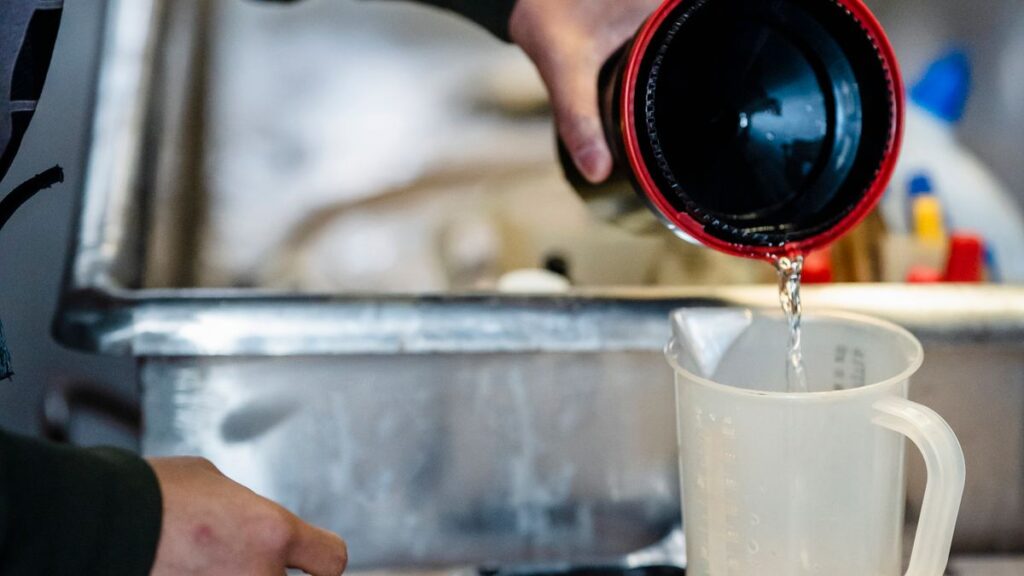
How to Convert Liters to Gallons in 5 Best Steps
These 5 best steps turn liters to gallons into a calm routine. Each step fixes one common error, so the set protects kitchen and fuel jobs. Follow the steps in order the first few times. The method will soon feel natural to you.
Step 1: Find the liters on the label or recipe. Read the container, recipe, or manual first, and note the exact liters. Check whether the number means capacity, current amount, or one serving. If the label shows milliliters, divide by 1,000 to get liters first.
Step 2: Check whether you need a US gallon or a UK gallon. Look at the country of the recipe, car, or guide. US sources use US liquid gallons, while UK sources use imperial gallons. If the source also gives liters, trust liters as your anchor.
Step 3: Pick the right formula for that gallon. Use division by 3.78541 for US gallons, or by 4.54609 for UK gallons. You can also multiply by 0.264172 for US, or by 0.219969 for UK. Write the formula down, so a reader can follow your method.
Step 4: Do the math and round only at the end. Enter liters in a calculator, apply the formula once, and keep full decimals. Round to two decimals for recipes, or five decimals for exact fuel records. Rounding mid way can shift the answer, and that shift grows with larger tanks.
Step 5: Sense check the answer before you use it. Ask whether the gallon answer looks sensible next to your liters. US gallons should be near one quarter of liters, while UK gallons are near one fifth. If the answer looks far off, recheck the gallon type and formula first.
Liters to Gallons for Cooking, Fuel, and Travel
Cooking is where most people meet liters to gallons in daily life. A 5 liter soup pot holds 1.32 US gallons, so a one gallon US recipe needs less. Large pots, drink dispensers, and water jugs often show liters, even in US kitchens. Convert a pot size once, write it on a card, and skip repeat math. For more kitchen measures, see liquid measurement conversions and liters to cups converter.
Fuel is the second common case, and the gallon type changes a trip budget. A 60 liter tank equals 15.85 US gallons, so a US driver can plan stops easily. A UK driver with the same tank should use 13.20 UK gallons instead. Mixing these numbers makes fuel use look better or worse than it is. Always pair the gallon with the country of the car and pump.
Travel brings the same problem into rental cars, water tanks, and camping gear. A 100 liter water tank equals 26.42 US gallons, which helps a US traveler plan water. The same tank equals 22.00 UK gallons, which helps a UK traveler plan the same trip. Distance math abroad also matters, so see miles to kilometers and how to convert meters to feet for trip planning.
Mistakes That Make Liters to Gallons Go Wrong
The biggest mistake in liters to gallons is using the wrong gallon formula. Using the US formula for a UK source shifts the answer by about 20 percent. The fix takes only a few seconds each time you convert. Check the source country, pick the matching gallon, and write the gallon type down. That small habit removes the most costly error for good.
A second mistake is rounding too early, or rounding a small amount to a whole gallon. One liter equals only 0.26 US gallons, so rounding to zero or one destroys the result. Keep decimals through the math, and round only once at the very end. For recipes, two decimals are plenty, while fuel notes may need five decimals.
A third mistake is confusing dry gallons, liquid gallons, and liters in old sources. US liquid gallons are standard for water, milk, fuel, and most drinks today. US dry gallons appear in old farm measures, but rarely in modern recipes or car guides. If a source does not say dry, assume US liquid gallons for drinks and fuel. When in doubt, check liters on the label, since liters never change by country.
US Gallon vs UK Gallon: Do Not Mix Them Up
The US gallon and the UK gallon look alike, but they hold different amounts. One US liquid gallon equals 3.78541 liters, while one UK gallon equals 4.54609 liters. The UK gallon is therefore about 20 percent larger than the US gallon. A fuel figure in UK gallons will always look better than the same car in US gallons. Never compare two fuel figures until you know each gallon type.
History explains why two gallons still exist side by side today. The US customary system kept an older, smaller gallon size over time. The UK Imperial system set its own larger gallon through its own system. The UK Imperial gallon was set by the 1824 system, and it stays at 4.54609 liters. The US gallon stayed smaller, and it stays at 3.78541 liters today.
For gallon sizes in daily measures, see how many ounces in a gallon. That guide shows how ounces fit inside each gallon type. It can also help you spot a US or UK source from ounce counts. Pair it with this liters to gallons guide for most volume questions. Keep both guides saved, and you will rarely guess about gallons again.
Verified Numbers You Can Trust for Liters to Gallons
The first verified number is the US definition, stated plainly with its source. One US liquid gallon equals exactly 231 cubic inches, which equals 3.785411784 liters. The source is the National Institute of Standards and Technology (NIST), which publishes US customary definitions. NIST defines the US gallon through the cubic inch, so the liter value follows exactly. Use 3.78541 daily, and keep the full value for exact records.
The second verified number is the UK definition, stated plainly with its source. One UK imperial gallon equals exactly 4.54609 liters in modern use. The source is the UK imperial system definition, as used in UK weights and measures law. The UK Imperial gallon was set by the 1824 system, and its liter value is fixed. That fixed value keeps UK conversions stable, so you can trust the UK formula here.
The third verified set is the reciprocal pair for fast multiply math. One liter equals 0.264172 US gallons, the reciprocal of the US definition above. One liter also equals 0.219969 UK gallons, the reciprocal of the UK definition above. These values come from the same NIST and UK imperial definitions, not from guesses. The liter belongs to the International System of Units, which the BIPM (International Bureau of Weights and Measures) oversees worldwide.
Estimating Liters to Gallons Without a Calculator
This unique section helps you estimate liters to gallons with no calculator near you. The divide by 4 rule works well for quick US gallon estimates. Divide liters by 4, and you land close to the true US answer. For example, 20 liters divided by 4 gives 5 US gallons, while the exact answer is 5.28. The estimate runs a little low, so add a bit when precision matters for fuel.
The quart, pint, and cup chain gives a second fast kitchen check. One liter is close to one quart plus a little more, since one quart equals 0.946 liters. Four cups make one quart, and two pints make one quart, so one liter is just over four cups. Ten liters is therefore just over ten quarts, or just over two and a half US gallons. This chain helps in kitchens, since cups and quarts appear on jugs and bowls. For small amounts, our cups to ml converter can cross check a recipe fast.
Use estimates only for rough plans, and switch to exact math for money or safety. An estimate off by 5 percent is fine for a water jug, but poor for fuel. For fuel stops, medicine, or science work, always use the full formula and calculator above. Write the exact answer next to any estimate, so no one mistakes a guess for a final figure. That habit keeps quick math useful without letting it mislead anyone.
Liters to Gallons Quick Checklist
Use this checklist each time you work with liters to gallons, and tick each item first. It takes under a minute, and it catches the errors behind most wrong results. Keep it near recipes, fuel notes, or travel plans for repeat use.
- Find the exact liters first, and note whether the number is capacity, current amount, or one serving.
- Check the country of the source, and pick US gallons for US sources or UK gallons for UK sources.
- Use 3.78541 for US gallons, or 4.54609 for UK gallons, and do not swap the two formulas.
- Do the math with full decimals, and round only once at the very end of the conversion.
- Sense check the result: US gallons are near one quarter of liters, and UK gallons are near one fifth.
- Write the gallon type next to the answer, so no reader can mistake a US gallon for a UK gallon.
- Recheck with the calculator above when fuel, money, or safety depends on the final number.
Liters to Gallons: Frequently Asked Questions
How do I convert liters to gallons in the US? Divide liters by 3.78541 to get US liquid gallons, or multiply by 0.264172. For example, 10 liters divided by 3.78541 gives 2.64172 US gallons exactly. Keep full decimals during math, and round only at the end for a clean answer.
How do I convert liters to gallons in the UK? Divide liters by 4.54609 to get UK imperial gallons, or multiply by 0.219969. For example, 10 liters divided by 4.54609 gives 2.19969 UK gallons exactly. Use this formula for UK recipes, cars, and guides, and label answers as UK gallons.
How many gallons is 10 liters? Ten liters equals 2.64172 US gallons, which rounds to 2.64 US gallons daily. The same 10 liters equals 2.19969 UK gallons, which rounds to 2.20 UK gallons. Always state which gallon you mean, since the answers differ by about 20 percent.
How many gallons is 20 liters? Twenty liters equals 5.28344 US gallons, which rounds to 5.28 US gallons daily. The same 20 liters equals 4.39938 UK gallons, which rounds to 4.40 UK gallons. This size fits many water jugs, drink dispensers, and small fuel cans at home.
How many gallons is 50 liters? Fifty liters equals 13.20860 US gallons, which rounds to 13.21 US gallons for travel. The same 50 liters equals 10.99829 UK gallons, which rounds to 11.00 UK gallons. Large water tanks and fuel drums often sit near this size, so gallon type matters.
How many gallons is 60 liters? Sixty liters equals 15.85032 US gallons, which rounds to 15.85 US gallons for US fuel planning. The same 60 liters equals 13.19790 UK gallons, which rounds to 13.20 UK gallons for UK planning. Many car fuel tanks sit near 60 liters, so match the car manual.
How many gallons is 100 liters? One hundred liters equals 26.41721 US gallons, which rounds to 26.42 US gallons for large tanks. The same 100 liters equals 21.99692 UK gallons, which rounds to 22.00 UK gallons. This size appears in water storage, rain barrels, and larger fuel tanks.
Why are US and UK gallons different? The US and UK kept different gallon sizes when their systems split in history. The US customary system kept a smaller gallon, while the UK Imperial system set a larger gallon. That split still shapes recipes, cars, and fuel guides in each country today.
Which gallon should I use for a US recipe? Use US liquid gallons for a US recipe, and divide liters by 3.78541. US cookbooks and food guides use US gallons unless they state a UK source clearly. If the recipe also gives liters or cups, use those numbers to cross check fast.
Which gallon should I use for a UK recipe? Use UK imperial gallons for a UK recipe, and divide liters by 4.54609. UK cookbooks and food guides use imperial gallons unless they state a US source clearly. If the recipe gives liters as well, trust liters and convert from them for safety.
Is a liter bigger than a gallon? No, a liter is much smaller than a gallon in both US and UK systems. One US gallon holds 3.78541 liters, while one UK gallon holds 4.54609 liters. You need several liters to make one gallon, so liters are the smaller unit here.
Can I use the divide by 4 rule for exact work? No, the divide by 4 rule is only a rough estimate for US gallons daily. It gives 5 US gallons for 20 liters, while the exact answer is 5.28 US gallons. Use the full formula for fuel, money, science, or safety, and keep estimates for rough plans.
What is the fastest way to avoid liters to gallons mistakes? Check the gallon type first, use the matching formula, and sense check the answer. US gallons should sit near one quarter of liters, while UK gallons sit near one fifth. Write the gallon type next to every answer, and recheck with the calculator when needed.
Does the same formula work for water, milk, and fuel? Yes, the same volume formula works for water, milk, fuel, and other liquids daily. Liters and gallons both measure volume, so liquid type does not change the factor at all. Weight conversions differ, since each liquid has its own density, so do not mix volume and weight math.
Final Word
Liters to gallons becomes easy once you separate the US gallon from the UK gallon. Use 3.78541 for US gallons, use 4.54609 for UK gallons, and sense check each answer. The table, the 5 best steps, and the checklist give a repeatable method for cooking, fuel, and travel. Keep this guide saved, and use the calculator above whenever an exact answer matters.
For your next volume question, start with how many ounces in a gallon, which pairs well with this liters to gallons guide. Then explore liquid measurement conversions for a wider set of kitchen and home measures. If distance math is next, see miles to kilometers and how to convert meters to feet for the same clear method. For small kitchen amounts, our cups to ml converter and liters to cups converter will finish the set for you.
Learn more about the gallon and its history here: Gallon